


Making Words
How did I end up screaming at the top of my lungs, literally pulling my hair out, and doubled-over in excruciating emotional pain? How did I end up curled in the fetal position at 4 a.m. sobbing and thinking my life would never be good?
This “dark night of my soul”, my “rock bottom” lasted for four years. I was trapped by a disease that I didn’t know I had. The disease called complex PTSD, given to me by a family ripped apart by domestic violence. This disease worsened throughout my life because of an unsupportive society, triggering relationships, and religious judgement. My four-year struggle peaked due to the legal system—lawyers, judges, hearings, trials—all conspired to destroy me from the inside out. Then I became unemployed, my financial debts climbed and I was diagnosed with cancer. Tortured, living in a nightmare, I tried something new.
ACA work—worked. I added The Big Red book, then The Yellow book, and The Loving Parent Guidebook to my daily schedule. I regularly met with fellow travelers, and I learned about my own dysfunctional Inner Family, who desperately needed to trust and care for each other. I knew the only way to happiness was by healing my inner family’s mess. But, how to get there involved a lot of mucking around in my painful past, and if I was going to do that, then I needed to give my Inner Children an easier, age-appropriate way to express themselves safely.
I remembered painting, maybe that would help, but what should I paint? Flowers? Trees? Animals? Faces? Whatever I decided would be the focus of my creative time. My Inner Kids said, “Focus on forgiveness.” How do I paint that? And then the idea came…instead of using recognizable objects as inspiration—I decided—paint the words. And something magic happened.
Words don’t look like things. Words are shapes and marks. When making letters I’m not copying what I see or what I remember. My Inner Critic couldn’t judge me and my ability to create a likeness. My expression—my voice—was not dependent upon an artist’s talent.
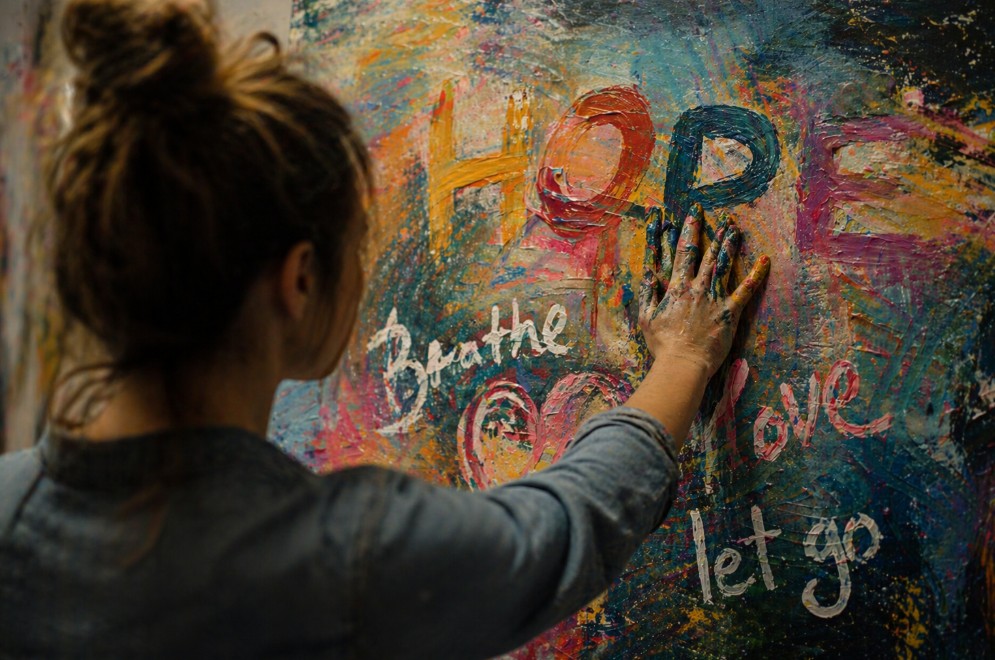
My Inner Children relaxed and enjoyed the simple application of paint onto a small canvas. I felt free to experiment with colors, tools, textures, solvents, additives, and techniques. “What if” became a motto. I started with brushes, but soon tried cotton swabs, sticks, and my fingers. I painted with kitchen tools, toothbrushes and items from the hardware store. I caked on thick applications next to running watercolors. I drew words and re-drew over them again, and again, and again. I focused on the making, not on the end product. I smeared, dotted, stenciled, dabbed, splattered, stroked, glued and made mistakes, like forgetting important words, not leaving space for letters, or not mixing enough color—and, mistakes didn’t matter. What mattered was the doing. The physical use of my hands bringing words to life.
What mattered was not quitting. At times my Inner Critic popped up, but my Loving Parent interceded between the coming judgement and my Inner Children. My Loving Parent encouraged me to finish the canvas in front of me—even if it meant layering on a new start—don’t change the canvas.
Sometimes I felt scared, stupid, crazy, frustrated. I’d think my work was ugly, worthless, trash, but told myself, “Don’t stop. Don’t throw it away. Work with what you have. Keep going. Try again—right here, on this same canvas, not a new one—this one—this painting that you think is ugly, worthless, trash—you can change it to your liking.”
And I did. And I do. And yes the metaphor is there—the canvas and the process is my actual, breathing life. The only real mistake would have been to throw away my canvas before the words were ready.
What about the final end products? The completed paintings are sometimes mantras, affirmations, sometimes the release of deep wounds. Words I didn’t hear or couldn’t say growing up and words I need today.
These creations are permanent reminders—that going through the worst can lead to something good.